
Fayette Tax Record Fields
Fayette County property tax records keep valuation and billing apart on purpose. Assessment cards list land, improvement, gross, and taxable values. The charge side tracks installments, payments, balance, and status.
| Field | What It Shows | Where |
|---|---|---|
| Land and improvement AV | Assessment components | Parcel card |
| Gross and taxable AV | Values before and after adjustments | Parcel card |
| Deductions and caps | Tax treatment for the year | Parcel card |
| Installments and balance | Charges and payments | Treasurer record |
| Tax district | Local rate context | Rate table |
Indiana assesses at market value-in-use, so an assessed value is not automatically a sale price or the consideration on a deed. DLGF ratio studies test assessments against selected study sales instead.
Search the Fayette Tax List
The Fayette tax list takes a parcel number, owner name, address, or tax year. Start with just one field. Piling on criteria can squeeze results down to nothing, and the result list caps out at 100 records anyway.
| Field | Best use | Caution |
|---|---|---|
| Parcel | Exact bill | Keep punctuation |
| Name | Owner bills | Try surname or entity |
| Address | Known site | City may be included |
| Tax year | Bill period | Do not mix years |
Recent parcel splits or combinations may require a surname search or Treasurer help.
Fayette Assessment Evidence
Read land and improvement values before you touch gross assessment. Taxable assessment can drop after deductions and caps. Inspected cards span agricultural, residential, and industrial classes. Pin the class to every comparison you make.
The Fayette 2025 ratio study lists parcel, township, neighborhood, class, district, sale date, and study price. It also lists land AV, improvement AV, total AV, and ratio. Treat it as assessment evidence, never as a price tag for some other parcel.
Look Up Fayette Tax Bills
The Fayette Treasurer portal gathers property-tax information, rates, statistics, a calculator, and parcel tools in one place. Open the right parcel and the right year before you read any charges.
- Search by address, owner surname, or parcel number.
- Confirm the parcel, situs, and selected tax year.
- Read assessment, deductions, installments, payments, and balance.
- Check any delinquent flag directly with the Treasurer.
- Assessed value
- The administrative value assigned for taxation.
- Tax rate
- The local rate applied per $100 of assessed value.
- Deduction
- An allowed reduction reflected on the tax record.
- Tax lien
- A claim arising from unpaid property tax.
Delinquent Fayette Tax Status
The delinquent search accepts parcel, owner, address, tax year, and a delinquent-only filter. A sample card marked "Eligible For Tax Sale" does not by itself prove an auction. It does not prove foreclosure, vacancy, or title transfer either.
Indiana's tax sale system runs on lien certificates and redemption. It operates under IC 6-1.1-24 and IC 6-1.1-25. The county publishes no confirmed auction schedule. Confirm live status with the Treasurer.
Fayette Rates and Districts
The rate table breaks out county, township, city or town, school, library, and total rates. Always use the parcel's own tax district. Samples show district 003 for Connersville City. Samples also show district 010 for Jackson Township.
A Connersville mailing address alone does not settle city tax status. Check the district, township, legal description, GIS, and annexation records before drawing conclusions.
Fayette's 2026 Tax Calendar
Indiana's published 2026 due dates are May 11 and November 10. DLGF describes a 5 percent penalty within 30 days under its stated condition. A 10 percent penalty comes later. Exceptions can apply, so check them.
The four-year cyclical reassessment began July 1, 2026. Roughly one quarter of parcels are slated for inspection or data updates each year. A value change does not require a sale.
Note: Keep the assessment, tax, and payable year attached to every Fayette figure.
Fayette Tax Access Offscreen
Web pages are not the only way in. The Fayette Treasurer, at 401 Central Avenue in Connersville or 765-825-1013, handles bill questions and parcel changes. The Assessor sits at 401 N Central Avenue, 765-825-4931, and covers assessment records and notices. Confirm current counter or service hours before you go.
A record may not be online. File a focused request under Indiana's Access to Public Records Act, IC 5-14-3. Name the parcel number, tax year, document type, date range, format, and how to reach you. The agency supplies existing public records. It does not have to build a custom tax analysis.
Note: Indiana access law does not override a confidentiality statute or turn an office into a title adviser.
Appeal a Fayette Assessment
Indiana usually sets June 15 of the Form 11 year as the local appeal deadline. If no Form 11 arrived, the deadline moves to June 15 of the following year. Start at the Fayette assessor's office. Form 130 opens the formal local appeal and can move on through PTABOA.
If state review opens up, the Indiana Board of Tax Review takes Form 131, with Form 130 and Form 115 attached where they apply. DLGF says an appraisal is not legally required to begin. Bring the property card, notice, measurements, photographs, repair facts, and comparable evidence.
Appeal window. File with the Fayette assessor by the applicable June 15 deadline and retain proof of delivery plus the exact tax-year record challenged.
The official DLGF appeal resource lays out the forms and the review path.
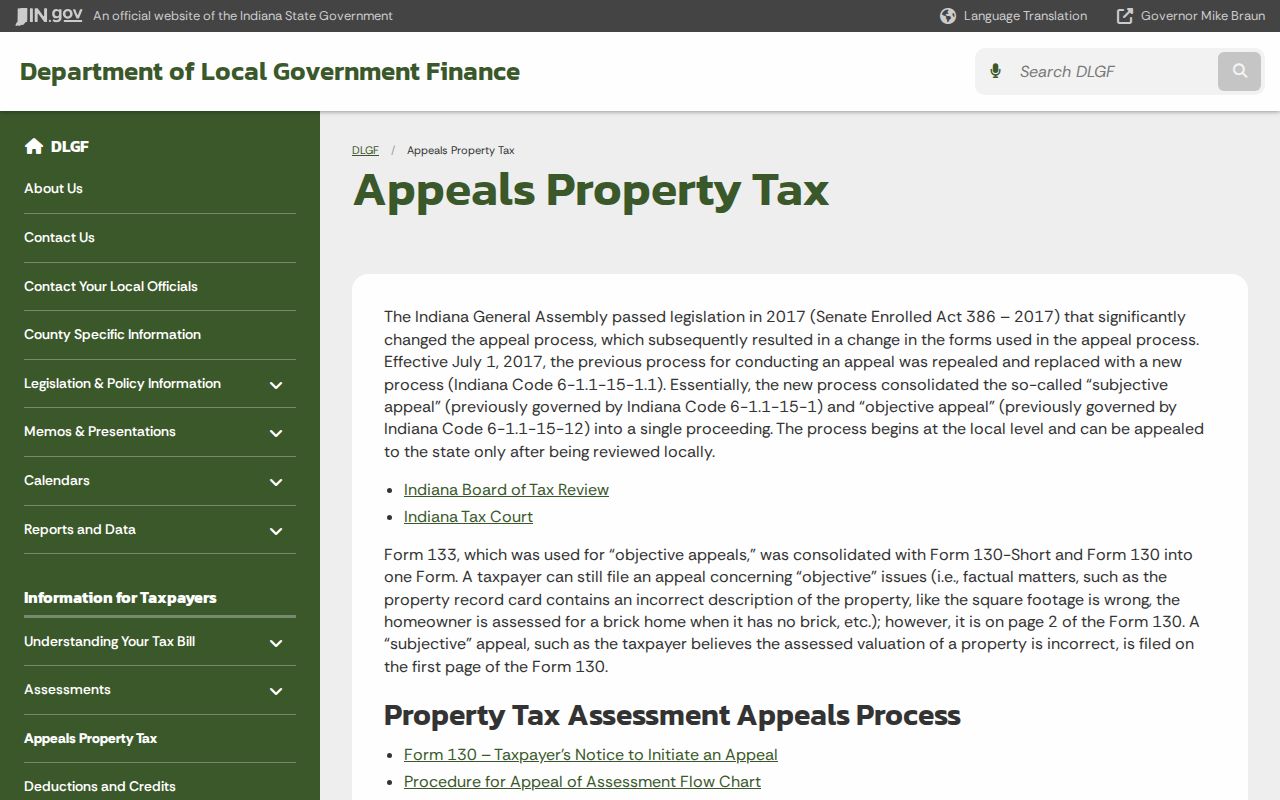
State guidance explains how appeals work, but the Fayette assessor receives the first local filing.
Compare Fayette Tax Years
Every Fayette property tax record belongs to its own year. The tax list offers a year selector. Parcel detail can show assessment history plus current charges. Save the year, parcel number, district, property class, land assessment, improvement assessment, gross assessment, taxable assessment, deductions, and bill status as one package. Mix a prior assessment with a current installment and you get a false comparison.
A permit or physical review can change parcel data without any deed transfer. Fayette's 2024 assessment narrative notes that the county permit system helps the Assessor update parcels. The 2026 cyclical reassessment can also refresh property characteristics. When a number moves, compare the underlying card rows. Compare the Form 11 notice too, before blaming the tax rate or assuming ownership changed.
Sale evidence belongs in its own column. DLGF's public Sales Disclosure resources cover disclosures after July 1, 2008. The ratio study draws on qualified sales for assessment analysis. A recorded deed can carry consideration. None of those amounts should quietly stand in for taxable assessment or the amount due.
Resolve Fayette Tax Mismatches
Fayette County tax records do not always agree. When the owner, address, or parcel number differs across systems, start with the small details before assuming a bigger error. Check the selected year and the full parcel suffix. Then compare the situs against the owner's separate mailing address, since an owner who receives mail elsewhere has not moved the property. Search business and trust names as the card prints them, with punctuation variants if needed.
Parcel changes deserve extra caution. The Fayette County tax page warns that properties split or combined in the prior two years may appear only under the owner's last name. Save both the old and new parcel numbers. The Treasurer or Assessor can supply the cross-reference. A map number helps, but it cannot replace the APN.
For payment or posting questions, contact the Treasurer. For value, class, deductions, or an appeal notice, contact the Assessor. Use Fayette County property search when the real problem is identifying the parcel, and Fayette property values to compare value types.
Document a Fayette Tax Review
Disciplined notes anchor any Fayette County tax review. Keep the parcel number, tax year, payable year, owner label, situs, tax district, and property class together in one place. Add land, improvement, gross, and taxable values, plus deductions, installments, payments, and the remaining balance. County pages update, so record the date of access. If a printed bill and the live page disagree, the Treasurer can explain posting status while the Assessor handles valuation and characteristics.
Read the legal description first. A Connersville parcel may use addition, lot, and block. Rural Fayette property can use quarter-section, township, range, section, and acreage. Similar street addresses do not prove two results are the same tax parcel. The APN and map number help, but recent splits and combinations may leave an old number in earlier years.
Two kinds of evidence matter for an assessment question. Measurements, class, construction, condition, and photographs address the record itself, while comparable sales and the DLGF ratio study address the market. The Form 11 identifies the challenged assessment. Organizing everything before the informal review gives the assessor a clear, parcel-specific issue.
Bill questions demand separating liability from title. A delinquent balance or tax-sale eligibility flag is a financial and procedural status. It does not prove a deed has issued. Confirm payments, statutory notices, redemption status, and any recorded tax deed through the responsible offices. Never infer ownership from a delinquent label.
Appeal forms divide the stages. Form 130 starts locally. PTABOA is the county review board. Form 131 takes an eligible appeal to the Indiana Board of Tax Review, and local supporting forms may also be required. Filing dates and attachments matter. Retain a complete copy and proof of delivery rather than relying on an unsaved web session.
Note: Fayette property tax records answer assessment and billing questions, but the newest recorded deed remains the source for transfers.
Fayette Tax Office Roles
Each Fayette County office owns a different slice of the property tax records. The Assessor keeps property characteristics and assessed value. The Auditor and the shared tax-list system tie those values to parcel records. The Treasurer takes bills, payments, balances, and delinquency questions. Route each issue to the office that owns the field. Do not ask one office to reinterpret another's record.
The Assessor sits at 401 N Central Avenue, Connersville, IN 47331, and lists 765-825-4931. The Treasurer is at 401 Central Avenue, phone 765-825-1013. Confirm current hours before a counter visit. Bring the parcel number, the tax year, and any notice. Also bring a clear description of the record or correction you need.
A written IC 5-14-3 request should name an existing record and the format you want. It should not ask staff to calculate a custom value or decide title. It should not ask them to build a report. Copy or direct costs allowed by law may apply.